The Gate Number or the Stand Name?
Stadium gate number or stand name: learn which clue to follow first, reach the right entrance and continue from the concourse to your seat.
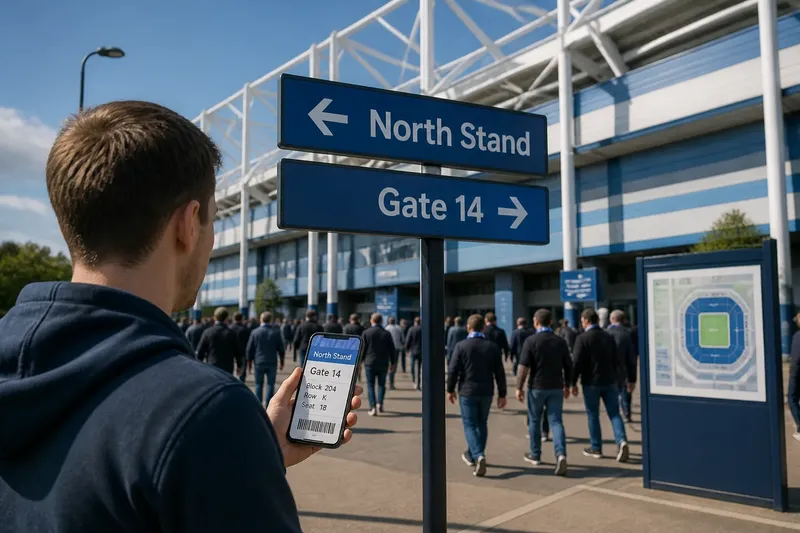
You are outside a stadium with your ticket open on your phone, and signs point towards both North Stand and Gate 14. For stadium wayfinding, follow the stand name first to find the right side of the venue, then use the gate number to reach your entrance.
The two labels answer different questions. A stand name gives broad orientation; a gate number identifies an access point. After entry, block, row and seat details take over. Treating these clues as a sequence is more useful than choosing one system over the other.
Read the ticket as a route from large areas to small ones
Separate the details on your ticket before setting off. The venue identifies the destination. The gate or entrance tells you where to enter. The stand names a broad seating area, while a block or section narrows it. Row and seat identify your final position.
These labels work at different scales. “East Stand” may cover a large part of a stadium, while “Gate 14” may be one of several entrances serving it. Searching for the stand alone could take you to the right side but the wrong door. Following only the gate could get you inside without showing which concourse to use.
Keep the ticket’s own wording in view. One venue may call an area a block, while another calls a similar area a section or bay. Do not assume that terms or numbering systems transfer neatly between grounds.
Use the stand name to orient yourself
At the perimeter, look for the stand name on an official map or a large external sign. Names such as North Stand or Riverside Stand provide a broad sense of location. They can be easier to remember than a series of gate numbers, especially when entrances sit close together.
A stand name may also connect to a nearby street, river or end of the pitch. That context can help you match the map to the building. But a name does not necessarily identify the door you need, and the most prominent stand sign may not mark the recommended approach.
Use the name to choose the part of the stadium you need, then check the venue map and signs for the entrance shown on your ticket. Fencing, closed routes or event arrangements may direct visitors to a different approach.
Use the gate number to find the entrance
Once you have identified the correct side, follow the gate number as a precise waypoint. Numbers are easy to match against a ticket, and a sequence of signs can help you judge where to walk.
Do not assume that gate numbers increase in the direction you are travelling. A venue may group them by stand, level or access route. Follow its map and on-site signs instead of guessing from the number alone.
Before joining a queue, check that the sign matches the entrance on your ticket. Keep your ticket ready, but remember that passing through the gate does not mean you are near your seat. The gate is the outer threshold; the stand and block still guide you indoors.
Follow the stand and block signs indoors
Inside, look for the stand name where a concourse branches or changes level. Then follow signs for your block or section. Use row and seat markers once you have reached the correct part of the seating bowl.
Say your ticket names East Stand, Block 204, Row K, and gives Gate 6 as the entrance. You compare Gate 6 with the venue map, find the East Stand side, and enter through the signed gate. Inside, you follow East Stand and then Block 204; at the seating area, you use Row K and the seat number. Each detail narrows the route, so if a sign points away from the named stand, you can stop and check with a steward before taking the wrong staircase.
At a confusing junction, compare the sign with your ticket rather than following a nearby number on instinct. A steward can clarify which route serves your block. It is not worth trying to memorise every gate around the stadium or the history behind every stand name; focus on the labels that connect your ticket to the signs you will meet.
Choose a meeting point that people can find
For a group arriving separately, agree on a meeting point that is both clear and accessible. A stand name alone may cover too much ground. A gate number is more precise outside, but could be difficult to reach after ticket control.
Imagine you and a friend have tickets listing North Stand and Gate 9. You agree to meet outside the signed Gate 9 entrance before entering. If one of you arrives late, both the stand name and gate number narrow the search. For a meeting inside, choose a named concourse feature or another location both people can reach without leaving the secure area.
Which clue should you follow first?
Does a gate number identify my seat?
No. It identifies an entrance or access point, while the stand, block, row and seat guide you inside. Check the ticket for the full set of details.
Should I follow the stand name or gate number outside?
Use the stand name to orient yourself towards the right part of the stadium, then follow the gate number printed on your ticket. If the map or event signs specify another approach, follow those directions.
What should I follow after entering?
Look for your stand or section, then follow the block or bay signs. Use row and seat markings when you reach the correct seating area.
What if my ticket shows a gate but no stand?
Enter through the gate shown, then check the remaining ticket details for a block, section or other seating clue. If signs do not make the route clear, ask a steward rather than choosing a staircase at random.
For stadium wayfinding, remember the sequence: stand for the broad area, gate for the entrance, then block, row and seat. If a sign does not fit that route, pause and check it against your ticket before continuing.